
Diamonds on the Mohs Scale

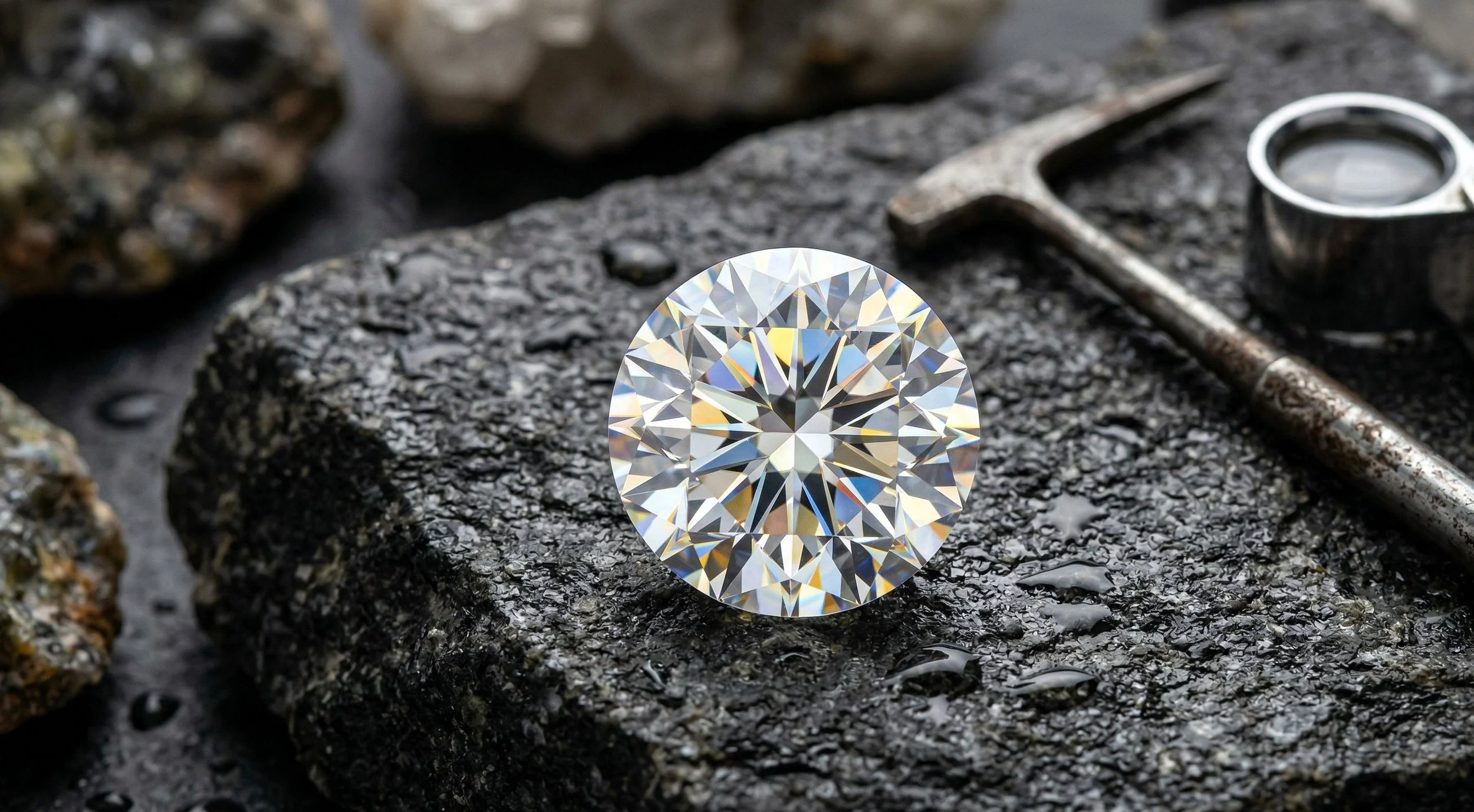
Lab-grown Diamonds and Mined Diamonds are ranked at the very top of the Mohs scale of mineral hardness, with a rating of 10.
This scale, which ranges from 1 to 10, measures a material's resistance to scratching.
Top Position: Diamond is the hardest known natural material on Earth.
Exponential Difference: While the scale is ranked 1–10, it is not linear. A diamond (10) is actually 4 times harder than corundum/ruby/sapphire (9).
Scratch Resistance: A diamond can scratch any other mineral, but only another diamond can scratch a diamond.
Hardness vs. Toughness: Although diamonds are the hardest, they can still be chipped or broken (cleaved) if struck hard at the right angle, as they have a specific crystalline structure.
Visual Context on the Mohs Scale:
10: Diamond
9: Corundum (Ruby/Sapphire)
8: Topaz
7: Quartz
1: Talc (Softest)
The Science of Durability:
Why All Diamonds at Mr Jeweller Rank a Perfect 10
When you are choosing a piece of fine jewelry—especially an engagement ring or wedding band meant to be worn every day for a lifetime—durability is paramount. Everyone knows diamonds are hard. It is their signature trait, the reason they sparkle like nothing else and have symbolized eternity for centuries. But how hard are they, and how do gemologists prove it?
At Mr Jeweller, we want our customers to make decisions based on facts, not marketing myths. One of the most common questions we receive is whether lab-grown diamonds are as durable as their natural, mined counterparts. The definitive, scientific answer lies in a simple but brilliant tool: the Mohs scale of mineral hardness.
The truth is surprising to many, but undisputed by scientists: Both lab-grown diamonds and natural mined diamonds possess the exact same, highest possible rating of 10 on the Mohs scale. They are indistinguishable in their hardness because, fundamentally, they are the exact same substance.
Here is a thorough explanation of what the Mohs scale is, how it works, and why both types of diamonds achieve that legendary perfect 10 status.
What is the Mohs Scale?
Invented in 1812 by the German mineralogist and geologist Friedrich Mohs, the Mohs scale is the universally accepted standard for characterizing the scratch resistance of various minerals.
It is crucial to understand that the Mohs scale measures relative hardness through scratch resistance. It does not measure toughness, tensile strength, or impact resistance (meaning it won't tell you how well a gem will survive being struck by a hammer). It simply answers the question: Can this substance visibly scratch that substance?
The scale works on a ranking principle. A mineral with a higher ranking can visibly scratch a mineral with a lower ranking, but not vice versa. Gemologists use a simple set of tools—fingernails, copper pennies, glass shards, steel knives, and reference minerals—to test an unknown mineral's hardness by systematically trying to scratch it.
The Linear Illusion
The Mohs scale is an ordinal scale, ranking minerals from 1 (the softest) to 10 (the hardest). It is not linear, which is a common misconception. The increase in hardness between step 3 (Calcite) and step 4 (Fluorite) is noticeable but not dramatic.
However, the leap in absolute hardness between rank 9 and rank 10 is staggering.
While the step from 8 to 9 represents about a 100% increase in absolute hardness, Diamond (10) is about four times harder than Corundum (9). Corundum includes elite gems like Sapphires and Rubies.
When you choose a diamond (either mined or lab-created), you are truly stepping into a league of its own.

Why Lab-Grown & Natural Diamonds are Identical on the Scale
The most common myth in the diamond industry is that "lab-grown" means "synthetic," "imitation," or "softer." This is absolutely false. Lab-grown diamonds are not diamond simulants like cubic zirconia (which has a Mohs hardness of ~8.5) or moissanite (~9.25).
A lab-grown diamond is a real diamond. Its existence is defined not by its origin (above ground vs. deep underground) but by its substance.
1. Identical Chemical Composition
At the atomic level, both types of diamonds are composed of pure carbon (C) atoms. They are chemically identical.
2. Identical Crystal Structure
Hardness is determined by atomic bonding. Both lab-grown and natural diamonds arrange their pure carbon atoms in the exact same legendary cubic crystal lattice. Specifically, they form a robust tetrahedral network, where each carbon atom is locked into four others with incredibly strong covalent bonds.
This particular atomic geometry is the tightest and strongest structure known in nature. It is this structure, not the billion-year wait, that gives a diamond its hardness.
How Mr Jeweller Guarantees Perfect 10 Consistency
Nature's growth process deep within the mantle is erratic, volatile, and messy. It takes billions of years and often results in structural stress points, impurities (like nitrogen), and significant internal inclusions.
At Mr Jeweller, our lab-grown diamonds are created in tightly controlled technological facilities using the standard processes of High Pressure High Temperature (HPHT) and Chemical Vapor Deposition (CVD).
By controlling every variable—temperature, pressure, gas mixture, and time—we don't "force" the carbon to grow; we create the optimized environment where it chooses to form the perfect, stress-free tetrahedral lattice. Because the process is controlled, our lab-grown diamonds often achieve Type IIa purity (pure carbon with minimal stress) more consistently than nature does.
The Importance of the Perfect 10 for You
A diamond's perfect 10 rating isn't just a number; it is a promise of lifelong beauty.
Undisturbed Brilliance: Only other diamonds can scratch a diamond. This means standard household dirt, dust (which often contains quartz, Mohs 7), metal keys, and other jewelry will never mar the smooth, faceted surface of your diamond. Its ability to refract light and sparkle will remain undisturbed forever.
Daily Reliability: A diamond's scratch resistance is what makes it suitable for everyday wear. No other gem offers this absolute resistance to the inevitable abrasions of life.
At Mr Jeweller, we are proud to offer both natural mined diamonds and lab-grown diamonds. Regardless of the origin you choose, you are choosing the undisputed king of hardness. Both paths lead you to a perfect 10 rating on the Mohs scale, ensuring that the symbol of your commitment will endure as brilliantly as the day you first put it on.