
The Beginner’s Guide to Watches: How They Work, Who Makes Them, and How to Choose One
Why Buy a Watch?
You don't need a watch to know what time it is. Your phone, your car, and your microwave all handle that. Yet the watch world is thriving. People save for years for a particular model, and a well-made mechanical watch can still be running after three or four generations of owners.
The reason is that a good watch is more than a clock. It is a tiny machine, often made of well over a hundred parts, that you wear on your body. It carries the history of navigation, exploration, war, and spaceflight, along with centuries of national craft traditions. It is also one of the few things most of us own that can outlast us.
This guide is for the curious beginner. It starts with how watches work (quartz, hand-wound, automatic, and a few interesting hybrids) and then shows you how to read the watch on your wrist part by part. From there it tours the great watchmaking nations, Switzerland, Germany, Japan, and the fast-rising China, and ends with practical advice on buying and caring for your first good watch. A glossary at the end covers the jargon.
Part 1: A Very Short History of Carrying Time
For most of history, people shared time rather than carrying it. Sundials, water clocks, and later the great weight-driven tower clocks of medieval Europe told time for a whole town at once. Personal timekeeping became possible with the coiled spring. A mainspring stores a lot of energy in a small space, so clockmakers could finally shrink their work. In the early 1500s, craftsmen in southern Germany made some of the first portable spring-driven timepieces. Peter Henlein of Nuremberg is often credited, though the history is debated.
Those early watches were beautiful but inaccurate, sometimes off by an hour a day. Accuracy took a huge leap in 1675, when the Dutch scientist Christiaan Huygens developed the balance spring, a hair-thin coil that gives the watch's regulating wheel a steady, natural rhythm. Every mechanical watch made today still uses that principle.
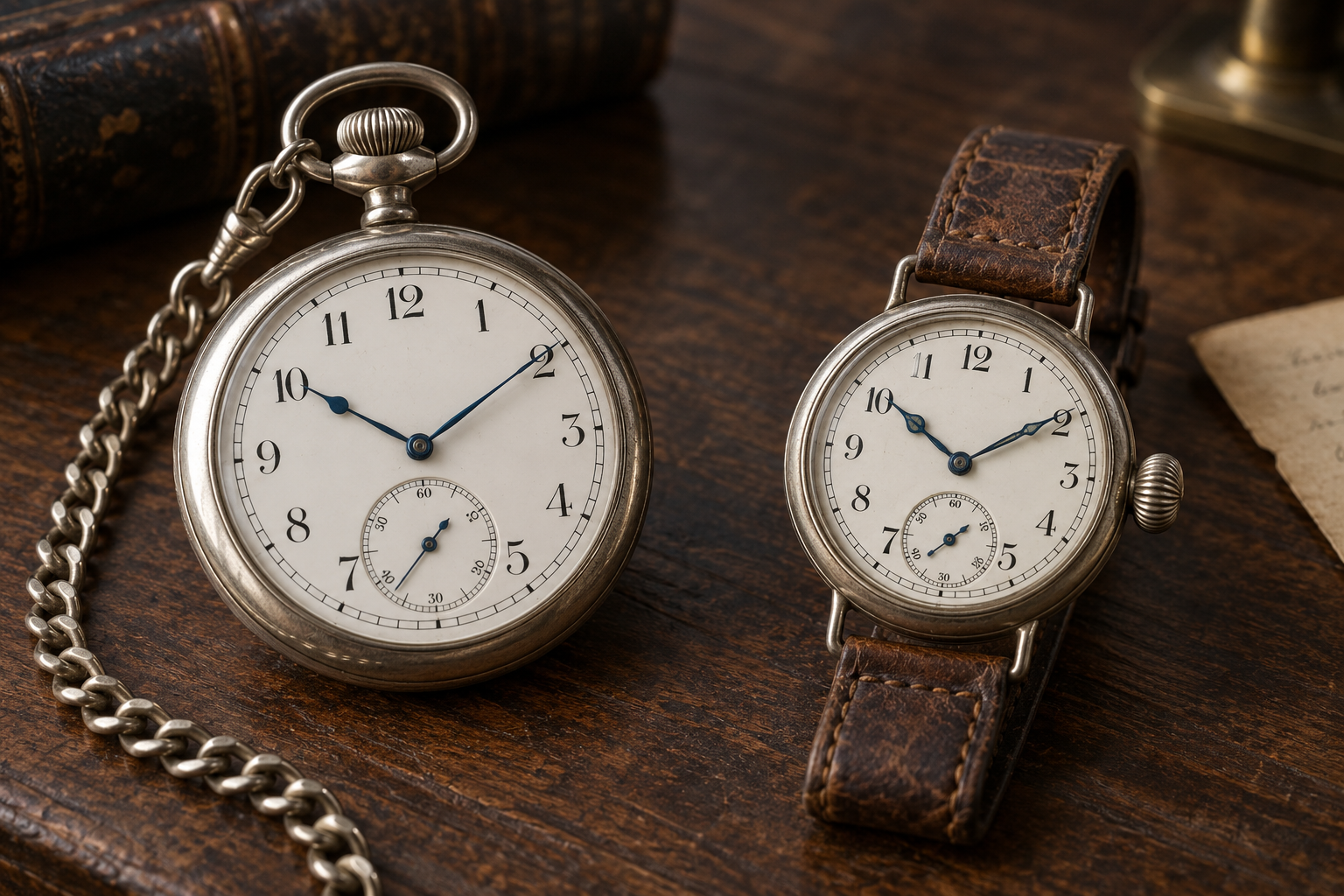
For the next two centuries, "watch" meant pocket watch. Wristwatches existed (a piece Breguet made for Caroline Murat, Queen of Naples, around 1810 is often cited as the first), but they were mostly seen as jewelry for women. World War I changed that. Soldiers in the trenches needed to check the time without digging into a pocket, and by the 1920s the wristwatch was standard for men as well.
Precision also became a matter of life and death. In the United States, strict “railroad grade” watch standards followed an 1891 train collision in Kipton, Ohio, blamed on an engineer’s watch that had stopped.
The twentieth century brought the waterproof case (Rolex's Oyster, patented in 1926), the self-winding wristwatch, and specialized tool watches for divers, pilots, and eventually astronauts. Then, on Christmas Day 1969, Seiko released the Astron, the world's first quartz wristwatch. Within about fifteen years, quartz had turned the industry upside down (see the Switzerland section below). In the 1990s, mechanical watches came back as objects of craft and luxury, and smartwatches have since added another category.
Today the market runs from $15 digital watches to handmade pieces costing more than a house.
Part 2: What’s Inside, Understanding Watch Movements
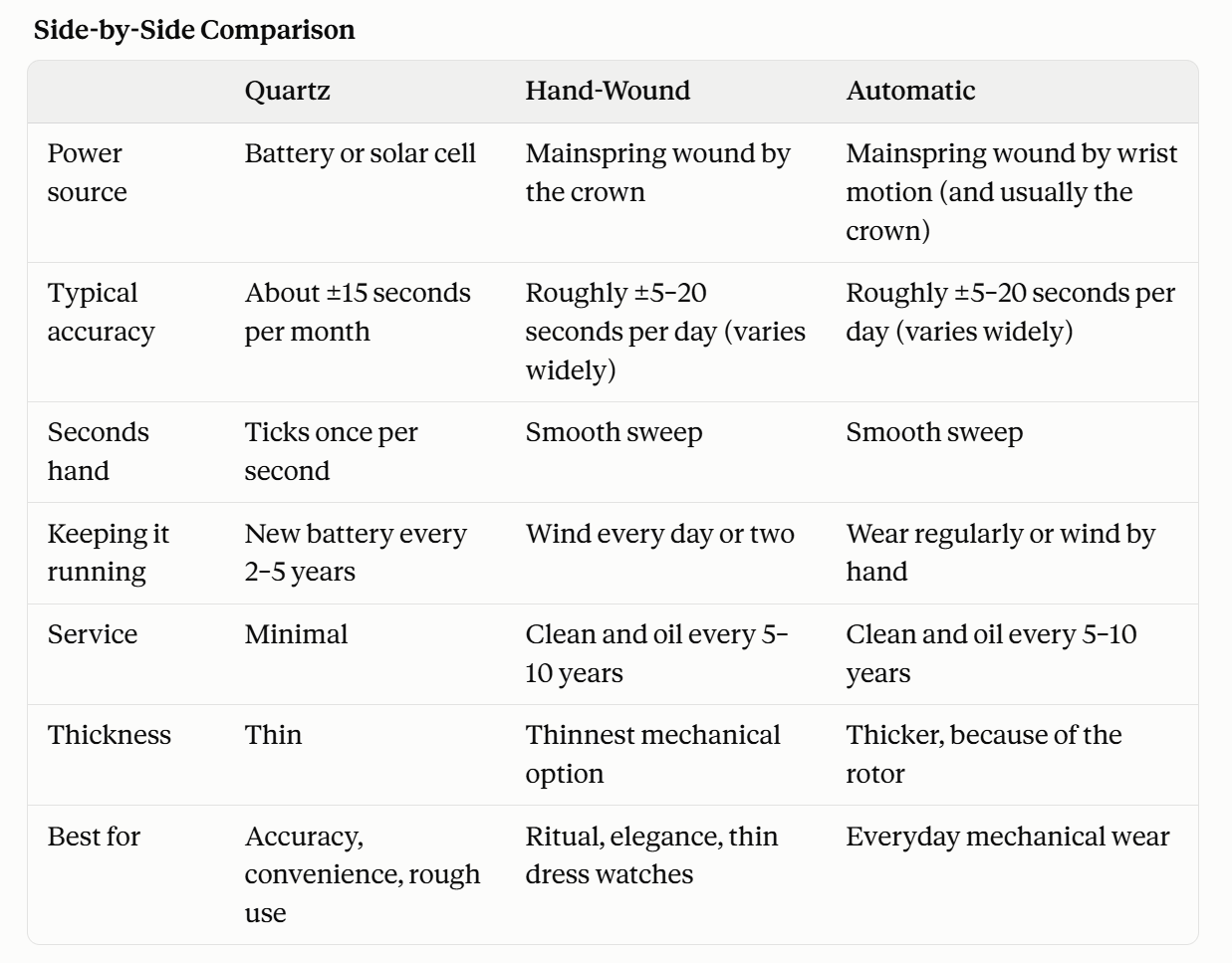
The movement (also called the caliber) is the watch's engine. Everything else, including the case, dial, hands, and strap, is the body built around it. Movements come in two families: quartz, which is electronic, and mechanical, which is spring-powered. Mechanical watches divide further into hand-wound and automatic.
Quartz Watches
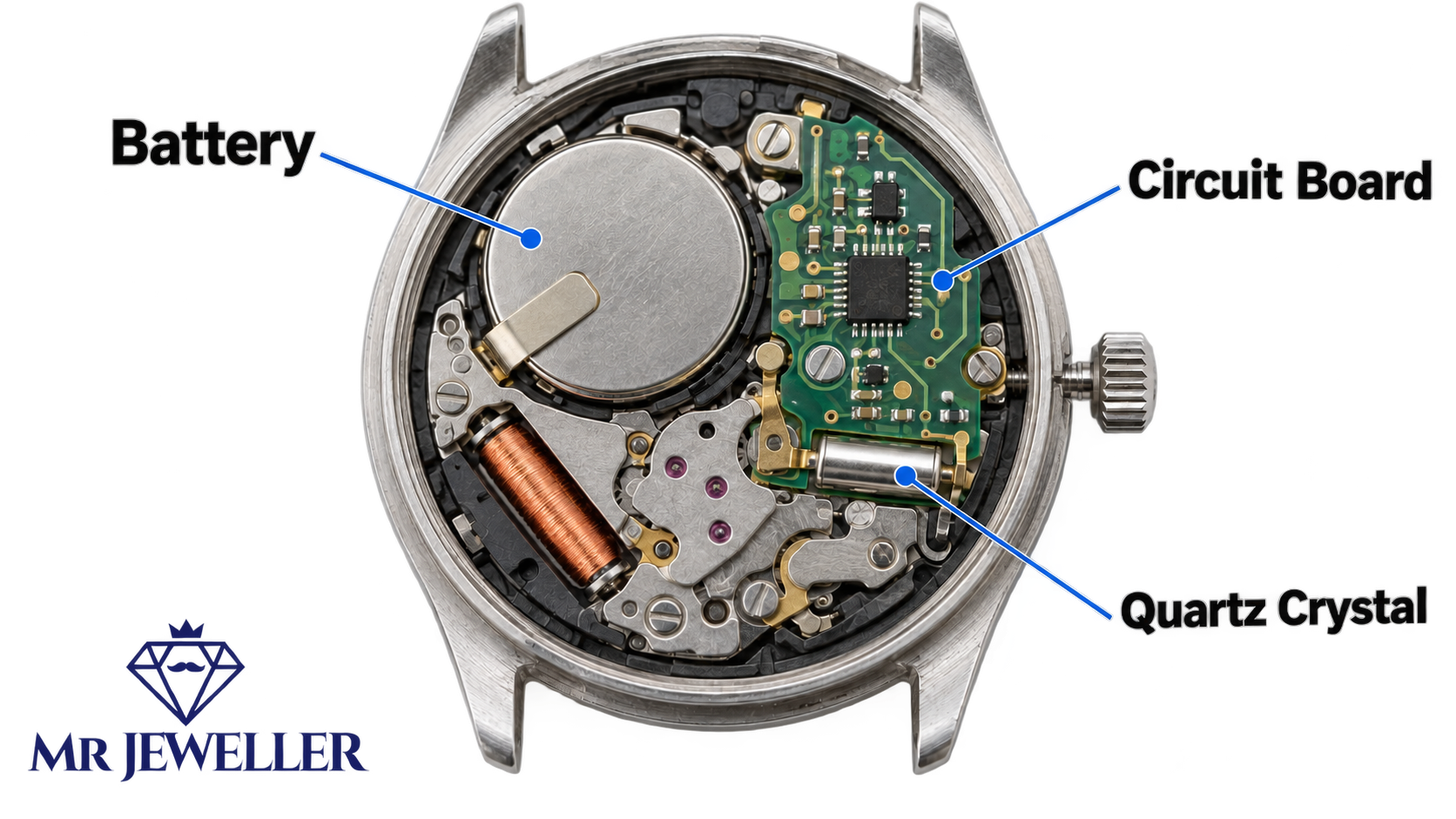
A quartz watch runs on a battery. The battery sends current through a tiny piece of quartz crystal cut in the shape of a tuning fork. Quartz is piezoelectric: when electricity is applied, it vibrates at an extremely stable frequency, which in watches is 32,768 times per second. A small circuit counts those vibrations. That number is 2 to the 15th power, so halving it fifteen times yields exactly one pulse per second. Once per second, the circuit sends a pulse to a tiny motor that moves the gears and hands.
For the owner, this means a few things:
Accuracy. A typical quartz watch stays within about 15 seconds per month, several times better than most mechanical watches. High-accuracy quartz models, which often compensate for temperature changes, can stay within 10 seconds per year or better.
Convenience. You grab it and go. A battery usually lasts two to five years.
Toughness. With few moving parts, quartz watches handle shocks well.
Cost. Quartz watches start at a few dollars.
You can usually spot an analog quartz watch by its seconds hand, which jumps once per second rather than sweeping.
Enthusiasts sometimes call quartz “soulless.” It is a circuit rather than a traditional craft object, and cheap quartz movements are often made to be replaced rather than repaired.
Don’t fall into that snobbery trap. Fine quartz watches from Grand Seiko, Citizen, Longines, and others are superb, and for someone who just wants a reliable timepiece, quartz is often the most sensible choice.
Quartz comes in several useful variations:
Solar quartz (Citizen's Eco-Drive, Seiko Solar) hides a solar cell under the dial, and the watch can run for months in the dark on a single charge.
Radio-controlled ("atomic") watches sync automatically with official time signals.
GPS watches set themselves by satellite.
Digital watches, made famous by Casio, show the time on an LCD screen.
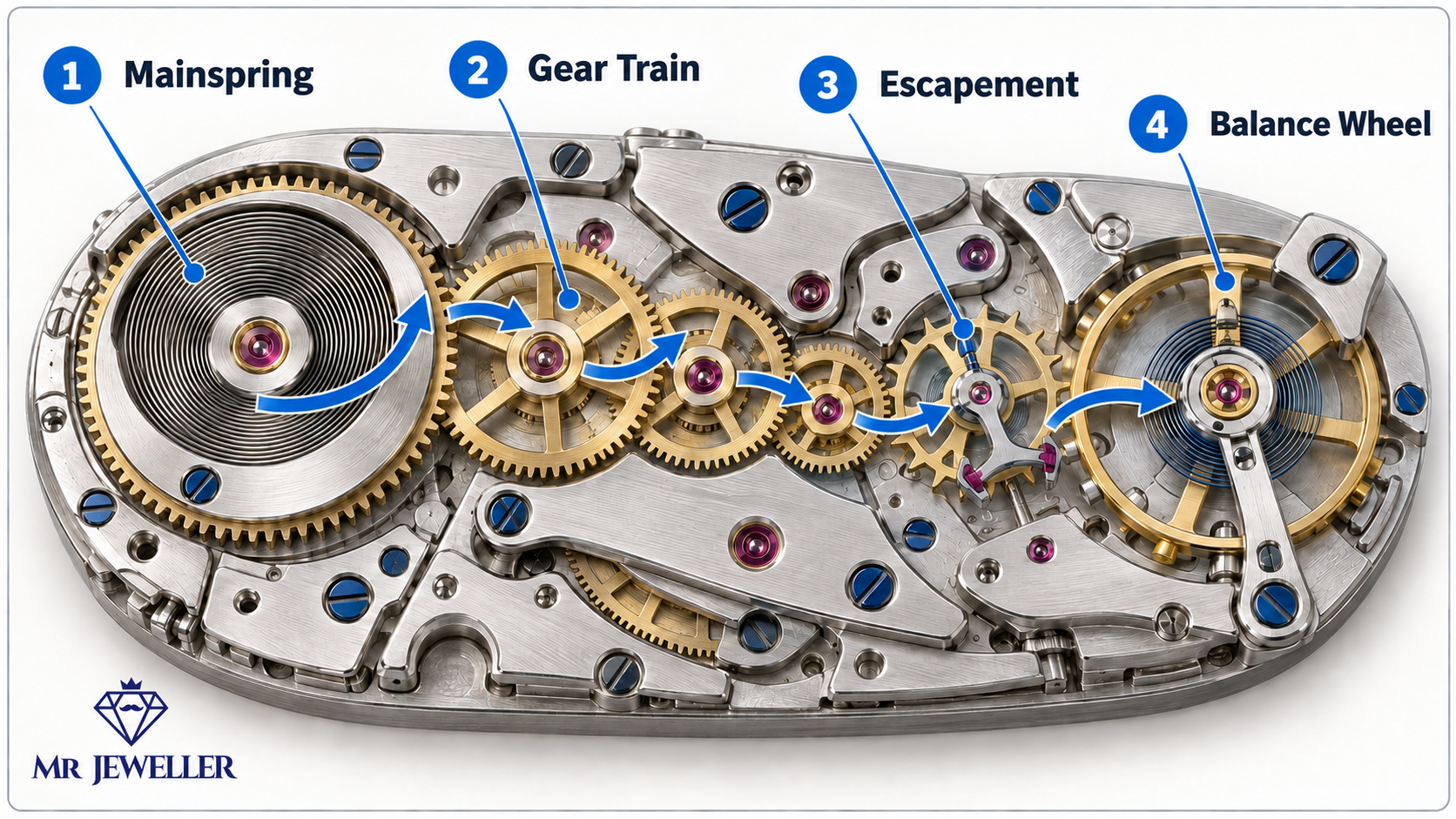
How a Mechanical Watch Works
Every mechanical watch, from a $100 automatic to a $500,000 masterpiece, follows the same basic energy flow. Think of it as a carefully controlled waterfall.
Mainspring. Energy starts here, a coiled ribbon of metal inside a small drum called the barrel. Winding tightens the spring.
Gear train. As the spring slowly unwinds, it pushes energy through a series of gears.
Escapement. If nothing controlled that energy, the spring would unwind in seconds. The escapement, an escape wheel working with a lever called the pallet fork, acts as a gatekeeper and releases energy in tiny, equal bursts. This is the tick-tock you hear.
Balance wheel and hairspring. The escapement is paced by the balance wheel, which swings back and forth at a fixed rhythm on its hairspring. This is the watch's heartbeat, and its steadiness decides how accurate the watch will be.
Motion works. A final set of gears turns that rhythm into the correct speeds for the hour and minute hands.
A few numbers show up on nearly every mechanical spec sheet:
Beat rate. Most modern watches beat at 28,800 vibrations per hour (4 Hz). The seconds hand moves in eight tiny steps each second, which creates the smooth "sweep" people love. Older and simpler movements often run at 21,600 (six steps per second). "High-beat" movements such as Zenith's El Primero and Grand Seiko's Hi-Beat run at 36,000 (ten steps).
Jewels. Synthetic rubies are used as bearings where parts rub, because they are hard and slick. A basic hand-wound watch is fully jeweled at about 17, and automatics usually have 21 to 27. More jewels than the design needs doesn't make a watch better. In the 1960s, some brands advertised inflated counts using jewels that did nothing.
Power reserve. This is how long the watch runs on a full wind. Traditionally it was about 40 hours. Many modern movements reach 70 to 80 hours, so the watch can sit through a weekend and still be running Monday morning.
Hand-Wound (Manual) Watches
The hand-wound watch is the original mechanical wristwatch. You wind it by turning the crown, usually once a day, about 20 to 40 turns, until you feel firm resistance. Then you stop. Modern watches are built so that normal winding to the stop does no harm; just never force the crown past it. Many owners come to enjoy the daily ritual as a small moment of connection with the machine.
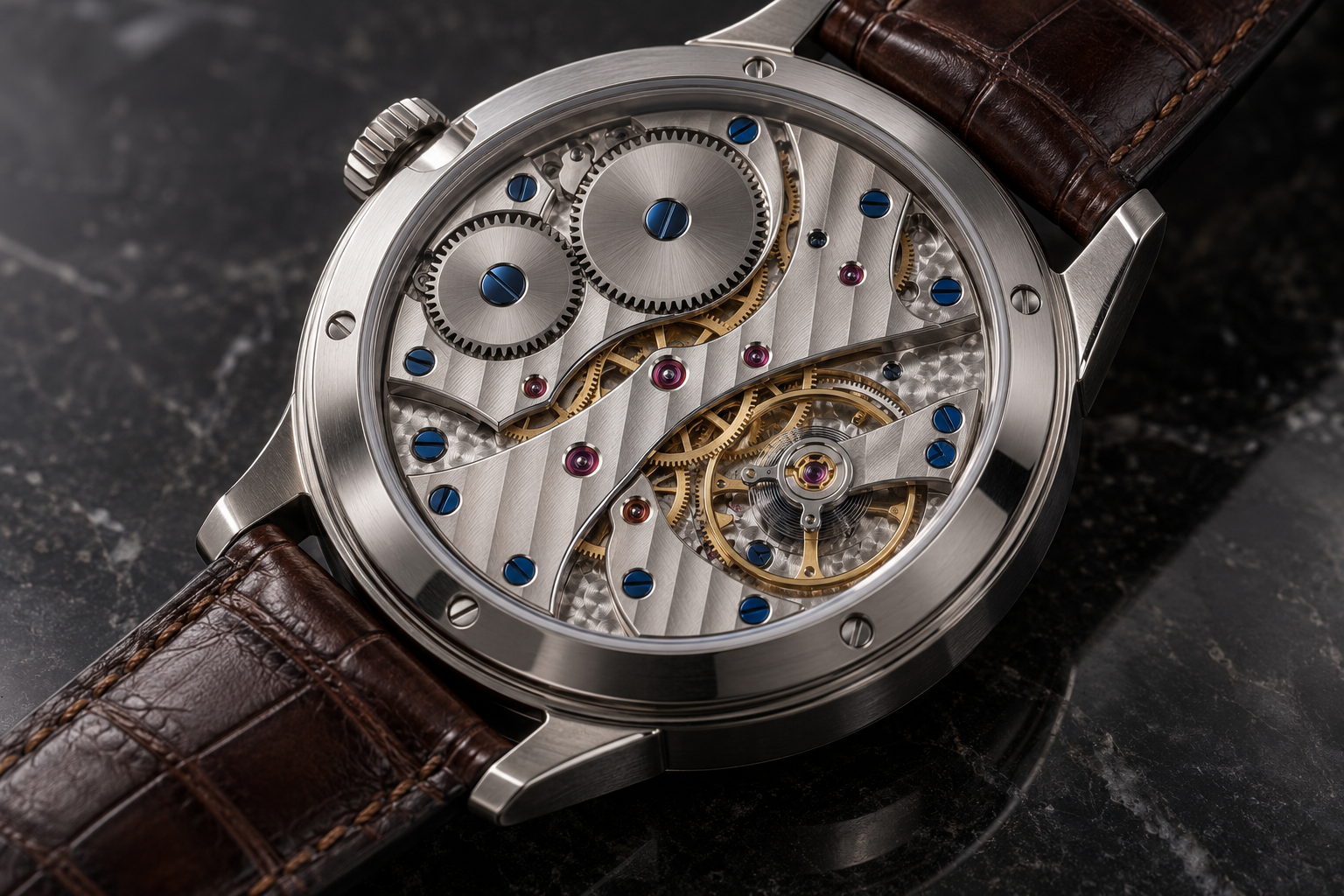
With no winding weight inside, hand-wound movements can be thinner, which suits elegant dress watches. They also give the clearest view of the movement through a display caseback, which is why so much of the finest hand-finishing in watchmaking appears on hand-wound calibers.
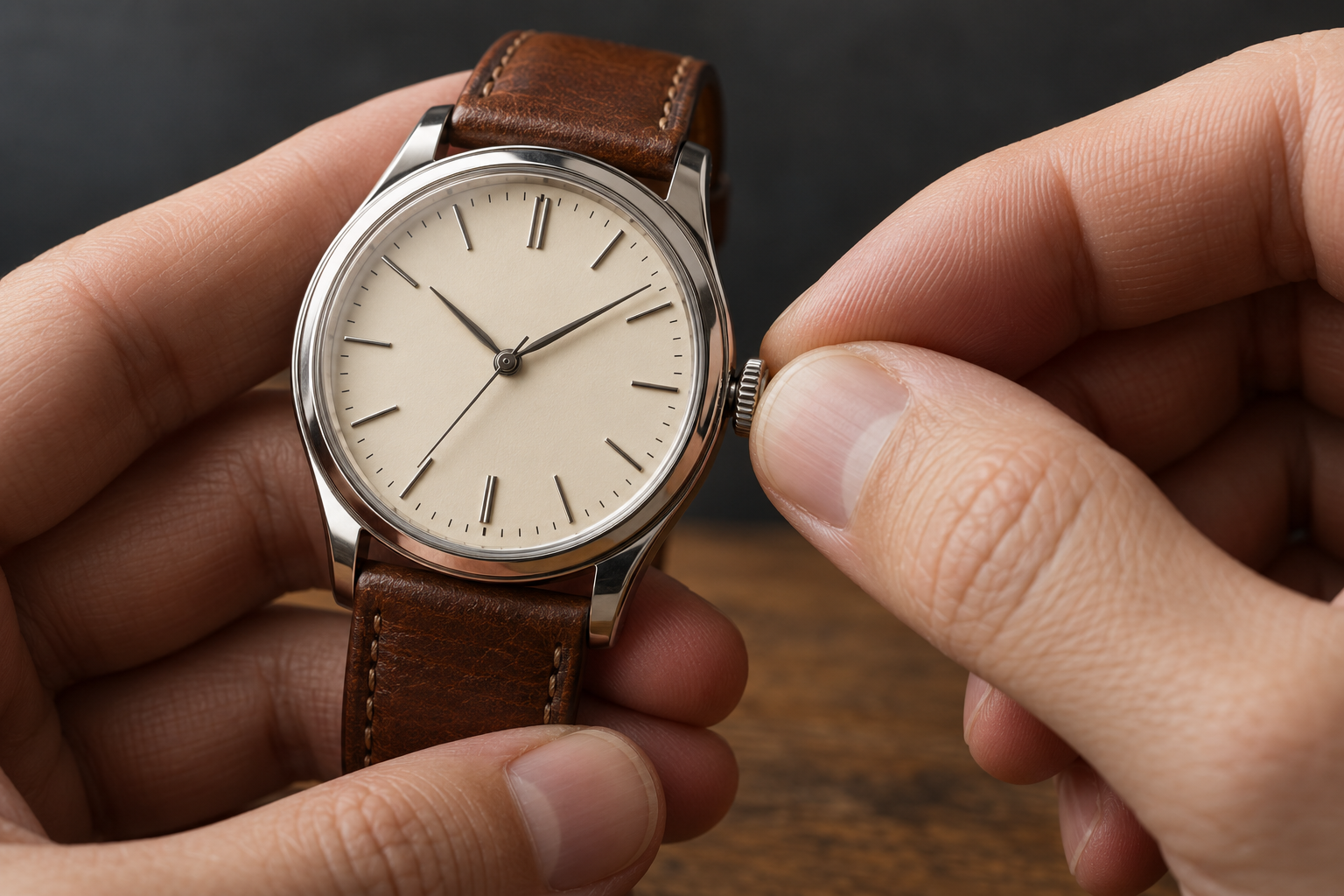
The best-known hand-wound watch is probably the Omega Speedmaster Professional, the “Moonwatch.” NASA qualified it for spaceflight in 1965, and astronauts wore it on the Moon in 1969.
Other well-known examples range from the affordable Hamilton Khaki Field Mechanical to the NOMOS Tangente and the A. Lange & Söhne 1815.
The drawback is simple: forget to wind it, and it stops.
Automatic (Self-Winding) Watches
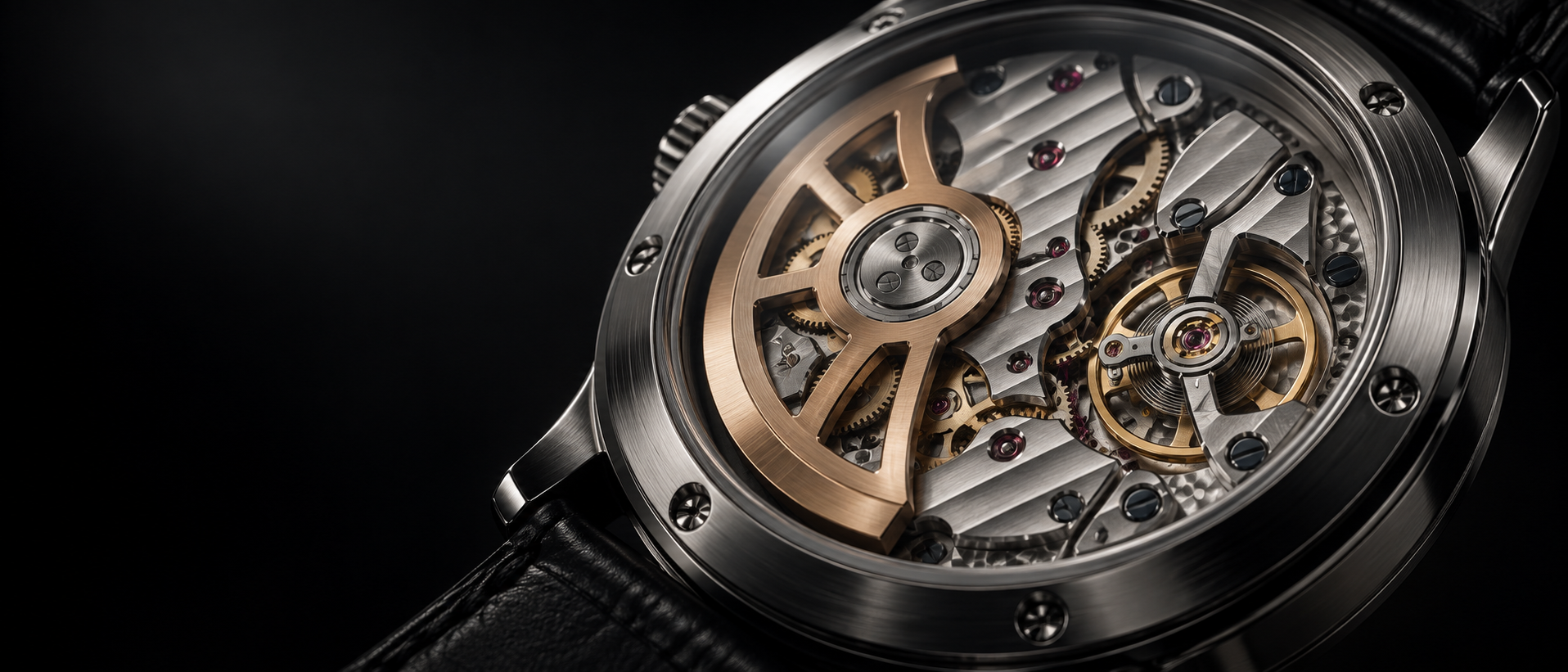
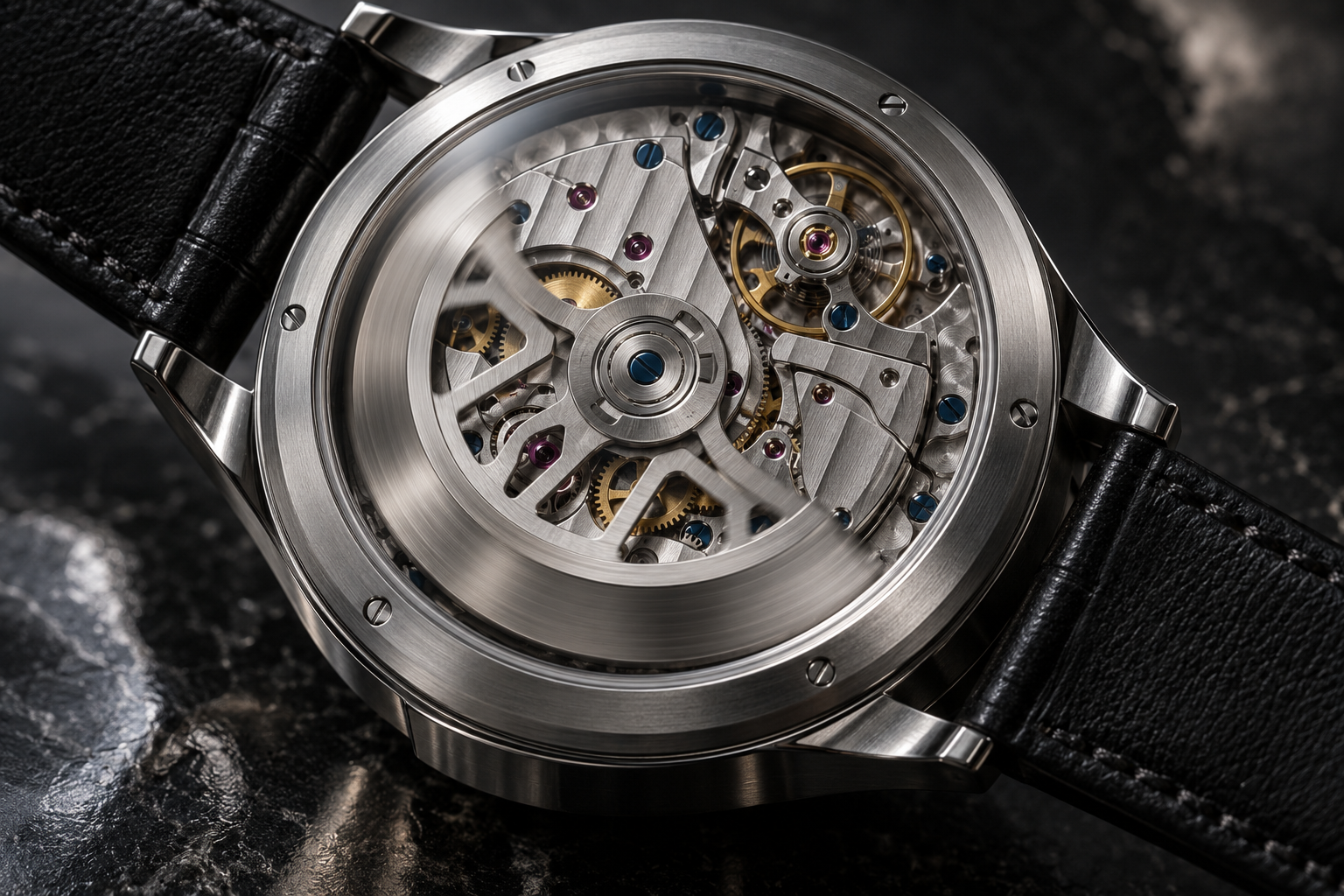
An automatic is a mechanical watch with a built-in winding system. A half-moon-shaped weight called the rotor pivots freely inside the case. As your wrist moves through the day, the rotor swings and, through a set of reduction gears, winds the mainspring. A slipping clutch keeps the spring from being overwound.
Self-winding pocket watches appeared in the late 1700s; Abraham-Louis Perrelet is commonly credited. The self-winding wristwatch came in the 1920s. In 1931, Rolex introduced its “Perpetual” rotor, which winds as it swings freely in a full circle. Nearly every automatic today uses that basic design.
If you wear an automatic daily, it stays wound. If you take it off on Friday, whether it's still running on Monday depends on its power reserve. Most automatics can also be wound by hand through the crown. If yours has stopped, a couple dozen turns is a better way to restart it than shaking it. (Some budget automatics can't be hand-wound, so check the specs.) Collectors with several automatics sometimes keep them in watch winders, motorized boxes that rotate the watches, but you don't need one.
Automatics are the most popular choice among enthusiasts because they combine the soul of a mechanical watch with everyday convenience. Movement names you'll see often on spec sheets include:
the Swiss ETA 2824-2 and its close cousin, the Sellita SW200-1
Seiko’s NH35
Citizen’s Miyota 9015 and 8215
China’s Sea-Gull ST2130
the Swatch Group's long-running Powermatic 80, used in Tissot and other brands
Hybrids and Other Movements
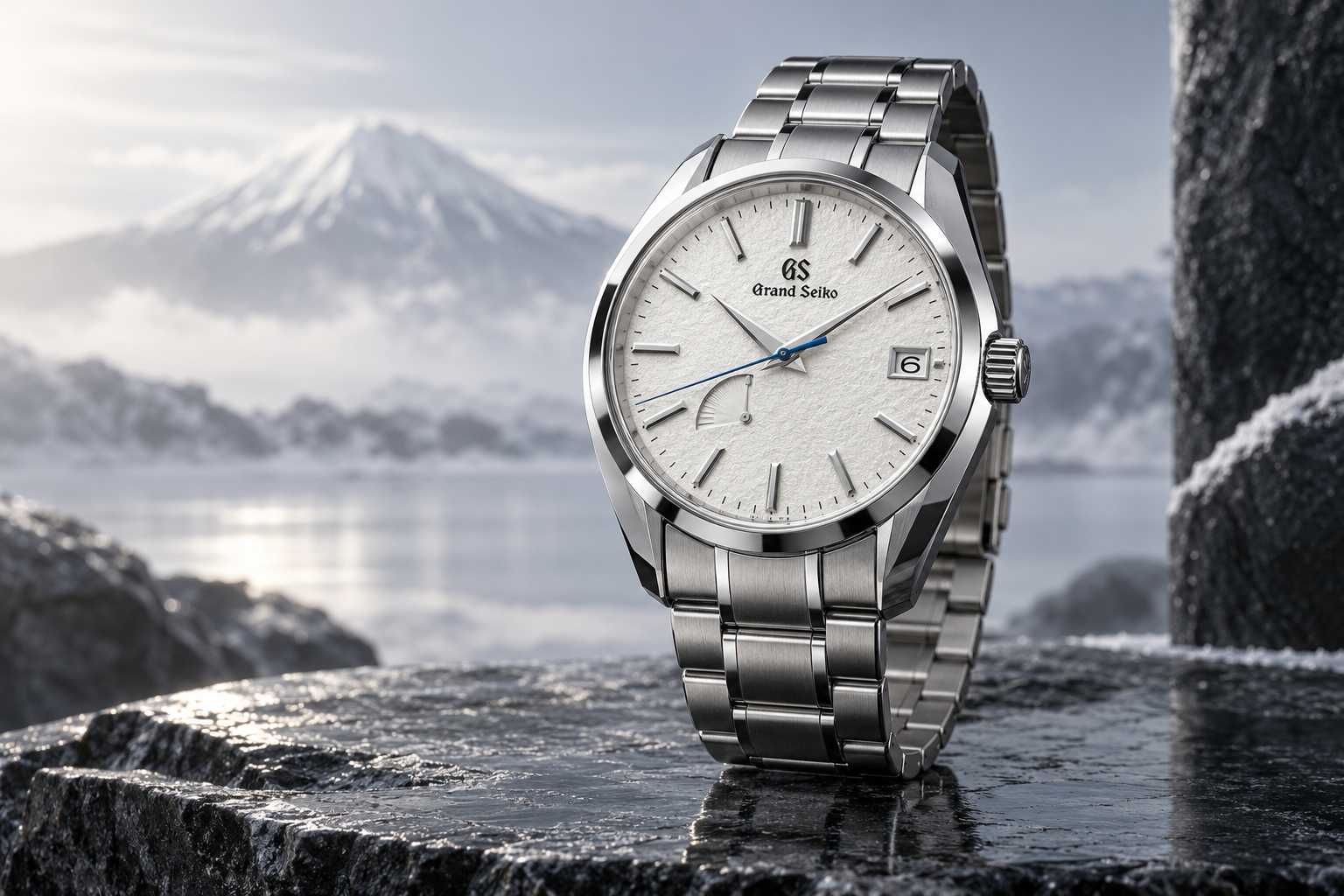
Seiko Spring Drive is one of watchmaking's most original inventions. A mainspring powers it like a mechanical watch, but a quartz crystal and a magnetic brake regulate it in place of a traditional escapement, and it has no battery. The seconds hand glides in one perfectly continuous motion, and accuracy is measured in seconds per month rather than per day. It is unique to Seiko and Grand Seiko.
Other hybrids and relatives:
Kinetic (automatic quartz) watches use a swinging rotor to generate electricity for a rechargeable cell.
Meca-quartz movements pair quartz timekeeping with a mechanical chronograph module, so you get the crisp feel of a mechanical stopwatch at a quartz price. Many microbrands use them.
Smartwatches are wrist computers that happen to tell time. They are outside the scope of this guide, but plenty of enthusiasts own both kinds.
“In-House” vs. Sourced Movements
A brand that makes its own movements is called a manufacture. Many excellent watches use movements from specialist suppliers instead, such as ETA, Sellita, Seiko, Miyota, and Sea-Gull.
Neither approach is automatically better:
Sourced movements are proven, affordable to service, and repairable by almost any competent watchmaker.
In-house movements can bring real innovation (longer power reserves, better magnetic resistance) and exclusivity. They may cost more to service and often have to go back to the brand.
The industry’s move toward in-house calibers sped up in the 2000s after the Swatch Group, which owns ETA, began limiting movement sales to outside brands. That pushed competitors to develop their own calibers and helped Sellita grow into a major supplier of movements based on classic ETA designs.
Part 3: How Accurate Is Accurate?
A mechanical watch that gains or loses a few seconds a day is working normally. Temperature, position (dial up, crown down), how fully it's wound, and nearby magnets all affect timekeeping. Several certifications give buyers a benchmark:
COSC is the Official Swiss Chronometer Testing Institute. It tests uncased movements for 15 days in five positions and three temperatures, and they must average between −4 and +6 seconds per day. When "Chronometer" appears on a Swiss dial, it has passed.
Stricter brand standards. Several companies go further. Rolex's "Superlative Chronometer" standard allows ±2 seconds per day after the watch is cased. Omega's "Master Chronometer" certification, run by the Swiss federal metrology institute (METAS), requires 0 to +5 seconds per day and resistance to strong magnetic fields. Grand Seiko tests to its own standard, which is stricter than COSC in several respects.
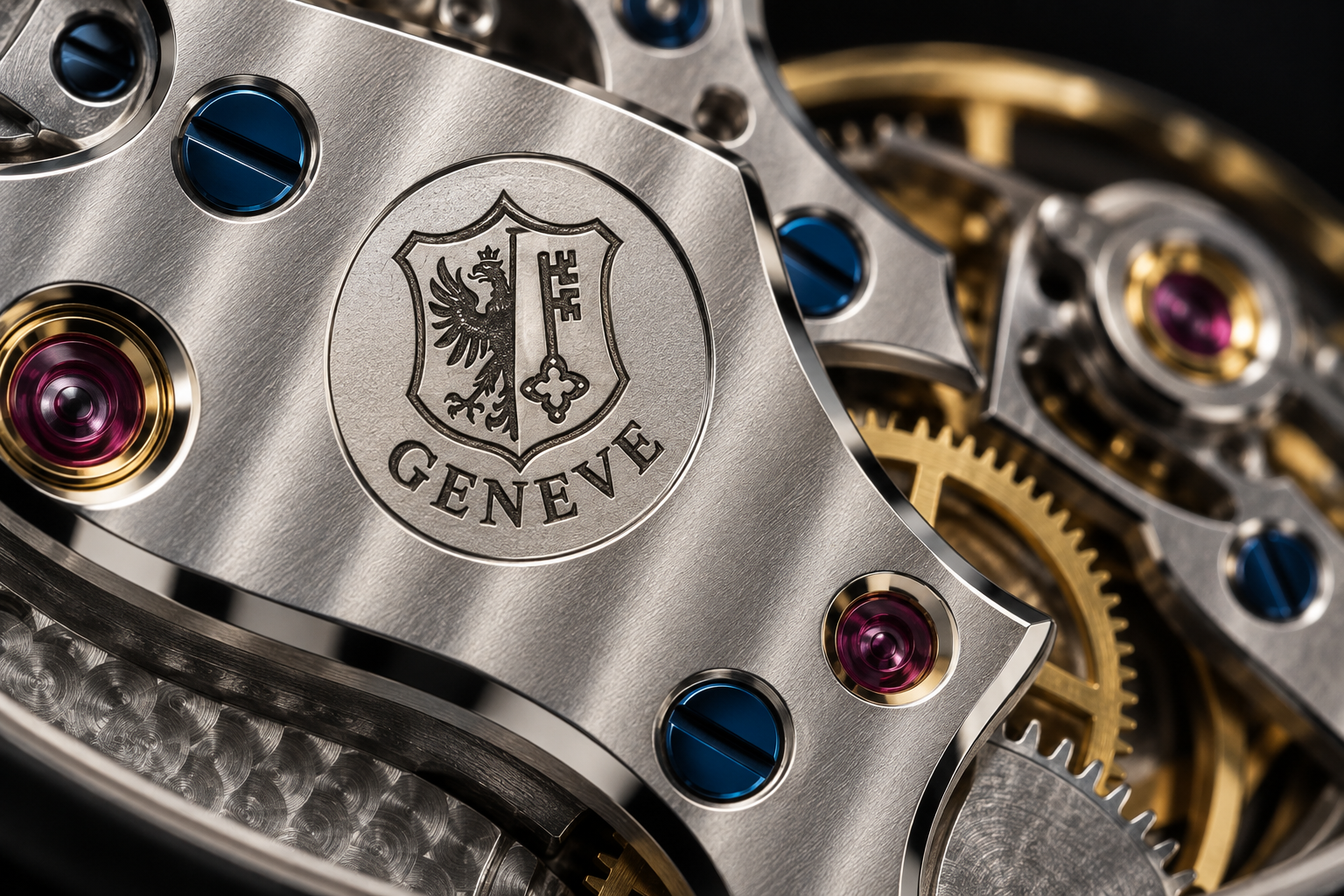
The Geneva Seal (Poinçon de Genève) is a hallmark for movements made in the canton of Geneva. It is mainly about quality of finishing and now includes tests of the finished watch.
Don't confuse chronometer (a certified accurate watch) with chronograph (a watch with a stopwatch function). A watch can be one, both, or neither.
Part 4: Anatomy of a Watch
Knowing the parts lets you read any product page or spec sheet with confidence.
The Parts
Case. The housing that protects the movement. The lugs are the horns that attach the strap, and lug width (commonly 18, 20, or 22 mm) tells you which straps will fit.
Bezel. The ring around the crystal. It can be a fixed, decorative ring or a working tool. A unidirectional rotating bezel on a dive watch tracks elapsed time, a 24-hour bezel on a GMT tracks a second time zone, and a tachymeter scale on a chronograph measures speed.
Crown. The knob used to set the time and wind the watch. On many sports and dive watches it screws down against a gasket to seal out water.
Crystal. The clear cover over the dial. Most quality watches use sapphire, which is extremely scratch-resistant (9 on the 10-point Mohs hardness scale) and often has an anti-reflective coating. Mineral glass is cheaper and softer. Acrylic (Omega calls its version "Hesalite") scratches easily but can be polished smooth and won't shatter into shards, one reason NASA liked it.
Dial and hands. The face of the watch. The hour markers are called indices.
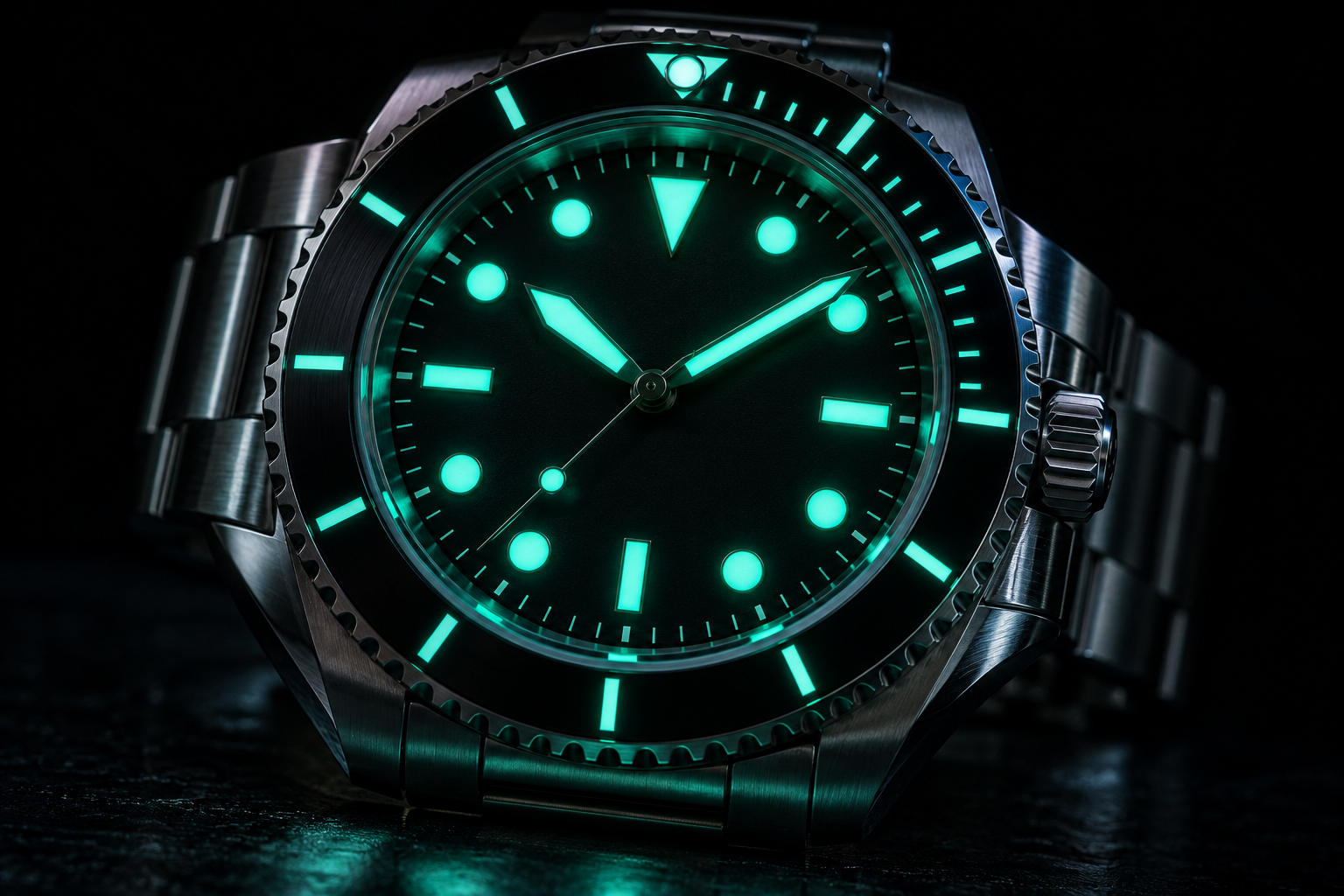
Lume. The glowing paint on the hands and markers. Early lume used radioactive radium, later replaced by tritium. Today's standard is non-radioactive, light-charged material such as Super-LumiNova (originally a Japanese invention) or Seiko's LumiBrite.
Caseback. Either solid, often engraved, or a display/exhibition back with a sapphire window onto the movement.
Strap or bracelet. Look for solid end links, a machined clasp, and a micro-adjustment feature on a bracelet, because your wrist swells in the heat.
Size
Case diameter gets the attention, but lug-to-lug length (the distance from the tip of the top lugs to the tip of the bottom lugs) often matters more. If the lugs hang past the edges of your wrist, the watch will look and feel too big. Thickness decides whether a watch slides under a shirt cuff. Many men's watches fall between 36 and 42 mm, many women's between 26 and 36 mm, and more and more designs are simply unisex. After a long run of oversized watches, the trend has swung back toward classic, moderate sizes.
Water Resistance
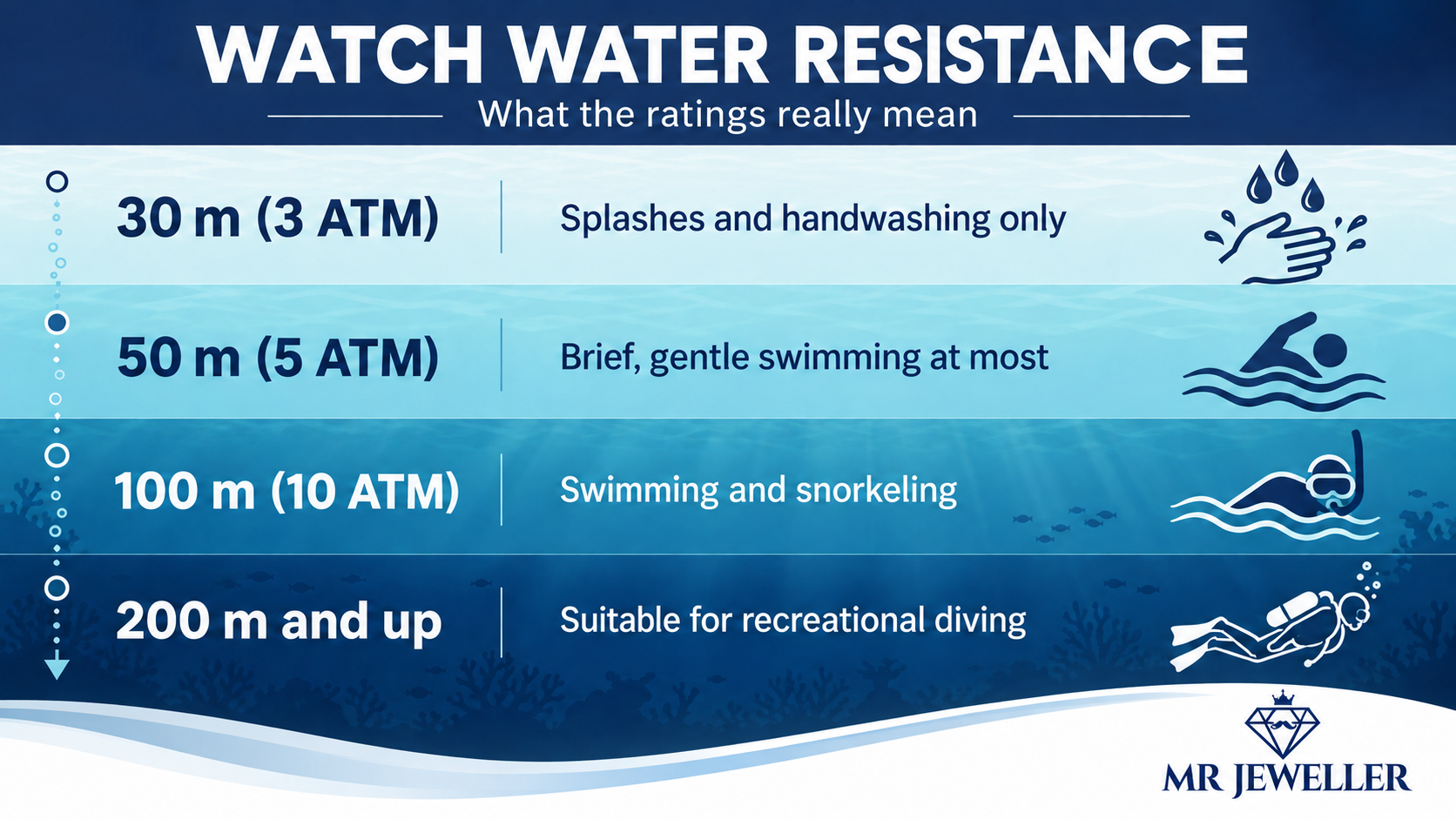
The depth ratings are notoriously misleading, because they come from lab pressure tests rather than real-world diving.
Materials
316L stainless steel is the industry standard.
904L steel is more corrosion-resistant; Rolex uses its own version, called "Oystersteel."
Titanium is light and hypoallergenic, but softer unless it has been hardened or coated.
Bronze develops a patina over time, like a copper roof.
Ceramic is extremely scratch-resistant but can crack if dropped.
Precious metals include yellow, rose, and white gold, and platinum.
Finishes matter too: brushed surfaces hide scratches, while polished surfaces catch the light.